Water Softeners
Block Salt vs Tablet Salt: Which Is Right for Your Softener?
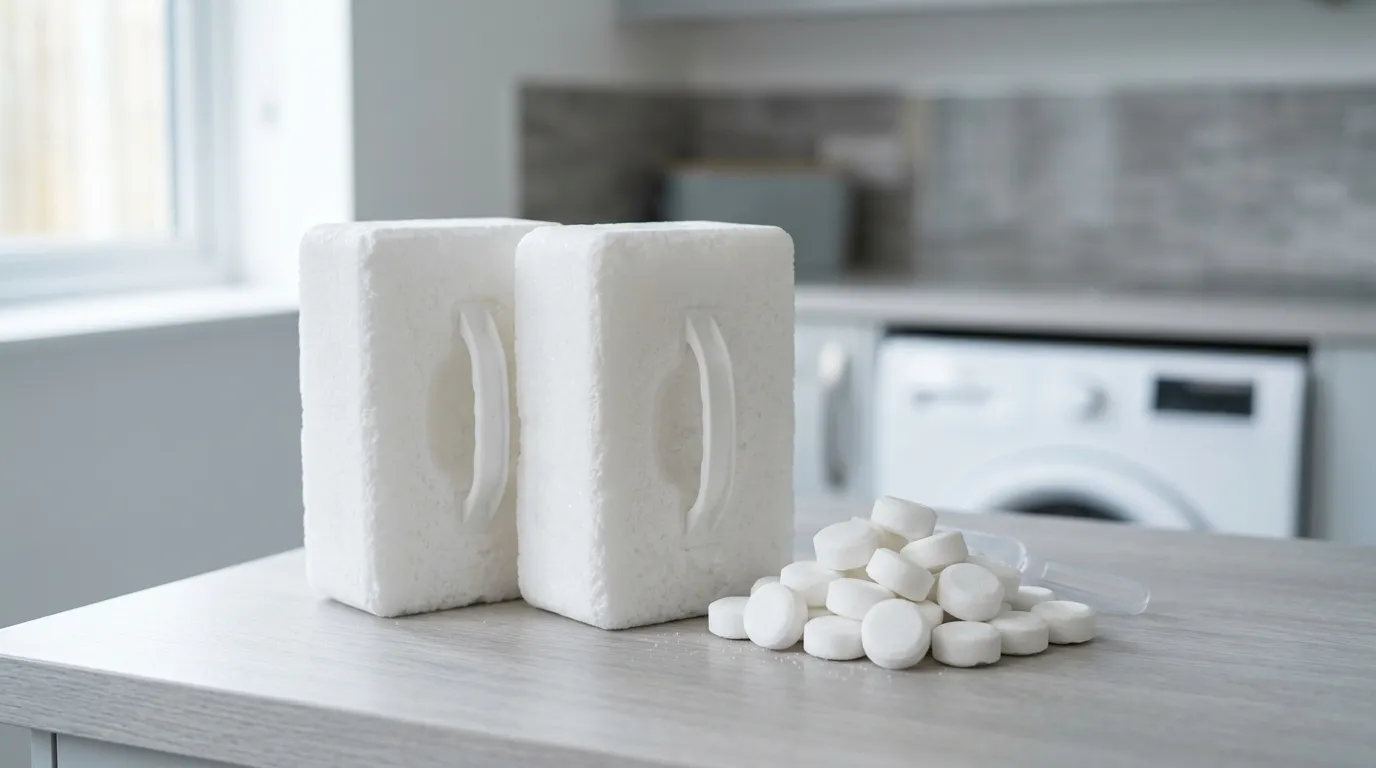
The short answer: it is not really a free choice. Your water softener is built around one type of salt, and the safest move is to use whatever the manufacturer specifies. Block salt suits machines designed for it, including most of the Harvey and TwinTec cabinet range and many Kinetico models, while tablet salt suits softeners built to take a loose granular or pelleted fill. Put block salt in a machine designed for tablets, or the reverse, and you risk poor regeneration, salt bridges, or a brine valve that jams.
Below is how the two actually differ, which softeners take which, and how to switch types properly if you need to.
The quick comparison
| Feature | Block salt | Tablet salt |
|---|---|---|
| Format | Two moulded blocks per pack, around 4kg each, with a carry handle | Loose pillow-shaped tablets, usually 10kg or 25kg bags |
| Lifting | Lighter single units, easier on the back | Whole bag is heavier, but you pour rather than lift a block in |
| Refill frequency | Often less often, since block machines tend to have small brine chambers | More per fill, but bags hold more salt at once |
| Salt bridge risk | Lower, the solid block dissolves from the base up | Slightly higher, loose tablets can crust over the water |
| Cost per kilo | Higher | Lower |
| Cost in use | Often similar overall, because block machines tend to be efficient | Lower if your machine is designed for tablets |
| Best for | Harvey, TwinTec, Gemini, Minimax, most Kinetico and other block-fed cabinets | Monarch Prosoft and Plumbsoft, BWT WS 255 and Perla, and other granular-fed machines |
The headline point most thin pages miss: the cost-per-kilo gap is real, but it is the wrong number to compare on. Many block-salt softeners are high-efficiency twin-tank designs that use less salt per litre softened, so the total annual spend often lands close to a tablet machine. Comparing the bag price alone tells you almost nothing about what you will actually pay.
How each type works in the tank
Both block and tablet salt are sodium chloride. They do the same chemical job: they make the strong brine that flushes the resin beads and recharges them to keep stripping hardness minerals out of your water. The difference is purely physical, in how the salt sits in the tank and dissolves.
Block salt sits as two solid slabs in a small brine chamber. The softener draws water up through the base, so the block dissolves gradually from the bottom and keeps the brine at a steady, predictable strength. Because there are no fine grains, there is nothing to wash into the brine valve and score the internal seals over time.
Tablet salt fills the tank as loose, compressed pellets. Hardened, pressed tablets are designed to resist crumbling, which is what separates good tablet salt from cheap granular salt: fine granular salt is the stuff that creates mush at the bottom of the tank and can be dragged across internal parts. As long as you use proper compressed tablets in a machine built for them, you get clean, even dissolving.
Which softeners take block salt, and which take tablets
This is the part to get right before you buy a single bag. Manufacturers publish compatibility lists, and the split is model-specific even within one brand. Based on Culligan Harvey’s own salt compatibility chart, the rough picture is:
Take block salt (including the curved Mini Curve block): HarveyArc, HVX, HV3, HV4 and Harvey Big Blue; the Minimax range; TwinTec models including the Cobalt and the S and XL series; Gemini; Kinetico Premier Compact, Premier Maxi, Sumo and Aqua-Blu; Monarch Ultra HE; and Scalemaster SL150 and SL450.
Take tablet or granular salt: Monarch Prosoft and Plumbsoft, BWT WS 255 and the BWT Perla range (which uses BWT Perla Tabs or Cubes), and the tablet-salt versions of softeners like the DualFlo and Scalemaster ranges that are sold in both block and tablet variants.
Several machines are flexible and will run on more than one type. The Scalemaster SL150 and SL450 accept granular, tablet or block salt, and Kinetico states its softeners are designed to take either block or tablet. Where a machine accepts more than one format, pick one and stick with it rather than mixing them in the same fill.
Two warnings worth repeating. First, some machines need a brand-specific curved block, not a standard rectangular one. The HarveyArc, the TwinTec Cobalt, the Minimax Innova and the Gemini V5, for example, are built around the smaller Mini Curve block rather than a standard block. Second, lists change with new models, so check your own user guide or the manufacturer’s current compatibility page before ordering. The manufacturer is the only true source here.
If you do not know your model, lift the lid. A small cabinet with a narrow brine chamber sized to hold two neat blocks is almost certainly a block machine. A wider tank you pour an open bag into is a tablet machine.
What salt quality should I look for?
For tablet salt, look for compliance with BS EN 973 Grade A (also written as Type A). That is the European standard for sodium chloride used to regenerate water-treatment ion exchangers, and it sets the high purity and physical specification, the tablet hardness and solubility, that keeps your machine clean. Good UK tablet salt is typically 99.9 per cent pure sodium chloride and is sometimes labelled PDV, pure dried vacuum salt. Block salt from the major softener brands is made to an equivalent high purity, the Mini Curve block is also produced to BS EN 973 Grade A, so you do not need to chase a separate spec sheet for it.
Avoid loose dishwasher salt, rock salt, or cheap granular salt as a substitute. The fine grains are exactly what manufacturers warn against drawing into the valve and seals.
Can I switch between block and tablet salt?
Sometimes, but only if your machine supports it. The first rule is that you cannot put block salt in a machine designed only for tablets, because the brine chamber and the draw geometry are different and the blocks simply will not dissolve correctly. Some softeners are dual-format: BWT, for instance, states that if you cannot get one type locally, a Perla softener will run on the other in the short term with no adjustment, and Kinetico softeners are designed to take either block or tablet. Check your own manual before relying on that.
If you are switching salt types within a compatible machine, do not just tip the new type on top of the old. Mixing two formats with different dissolve rates is what causes crusting and bridging. Instead:
- Run the softener until the salt level is very low, almost empty.
- Scoop out any leftover sludge or loose grains from the base.
- Add the new salt type from a clean tank.
That way both batches dissolve at the same rate and you avoid a half-dissolved layer setting solid.
How much salt will I get through?
There is no single figure, because consumption tracks three things: how hard your water is, how many people are in the house, and how much you use appliances like dishwashers and washing machines. Around 60 per cent of UK homes are in hard or very hard water areas, so most softener owners are at the higher end of usage. A typical family in a hard-water area will refill every few weeks, while a two-person household with softer supply water will go noticeably longer between top-ups.
To work out roughly what your own household will use and what that costs, try our water softener salt cost calculator. If you are not sure how hard your supply actually is, our UK water hardness checker gives you a figure by postcode.
The practical habit: keep the salt level at least a third full and never let it run dry, whichever type you use. A softener that runs out of salt stops removing hardness, and you will feel limescale creeping back within days.
Frequently asked questions
Is block salt better than tablet salt? Neither is universally better. Block salt is the right choice for machines built around it and is easier to lift in compact, mobility-friendly units. Tablet salt is cheaper per kilo and suits the softeners built to take a loose fill. The better one is whichever your softener is designed to use.
Can I use tablet salt in a block salt softener? Only if the manufacturer says so. Some softeners, such as the BWT Perla and the Kinetico range, are designed to take either format, but others will not dissolve the wrong type correctly. Never assume, check your manual first.
Why is block salt more expensive than tablet salt? Block salt costs more per kilo because of how it is compressed and packed, and because it is used in efficient twin-tank machines sold in smaller volumes. Over a full year the total spend is often similar to a tablet machine, since many block softeners use less salt per litre of water softened.
Does the type of salt affect how soft my water is? No. Both are sodium chloride and produce the same brine, so the softness of your water is the same. The difference is only in handling, refill frequency, cost, and which machine the salt is designed for.
Can I mix block salt and tablet salt in the same tank? It is best avoided. The two dissolve at different rates, which can leave a half-set, crusted layer in the tank. If you are changing types in a compatible machine, run the salt down to almost empty and clean the base before adding the new type.
What salt should I avoid putting in my softener? Avoid loose granular salt, rock salt, and dishwasher salt. Fine grains can be drawn into the brine valve and score the internal seals, which is one of the main causes of premature softener failure.