Limescale & Hard Water
How to Remove Limescale From a Shower Head
A shower head that spits sideways, dribbles, or has sprays firing off at odd angles almost always has the same cause: limescale clogging the nozzles. In a hard water area it builds up fast, and left alone it chokes the flow and eventually damages the fittings. The good news is that you can remove limescale from a shower head cheaply with things you already have, no special products needed. This guide covers the simplest methods, the plastic-bag trick for fixed heads you cannot unscrew, and the finishes you must be careful with so you do not ruin the head while cleaning it.
Why shower heads scale up so fast
Hard water carries dissolved calcium and magnesium. Every time the shower runs and the water evaporates around the nozzles, it leaves those minerals behind as chalky white limescale. Because the nozzles are tiny, it does not take much scale to block them, which is why the spray pattern goes patchy long before the rest of the bathroom looks furred up. If you want to understand the wider problem, our guide to hard water vs soft water explains what is actually in your supply.
Method 1: soak a removable shower head
If your shower head unscrews from the hose, this is the easiest and most thorough approach.
- Unscrew the shower head from the hose. Take out any rubber washer and set it aside.
- Put the head in a bucket or bowl and cover it completely with distilled white vinegar. Use distilled white, not malt or brown vinegar, which is less effective and can stain.
- Leave it to soak for around an hour so the acid dissolves the scale. See the caution below on brass and coated finishes, which must not soak that long.
- Lift it out, then scrub the nozzles and the faceplate with an old toothbrush to shift any softened scale.
- Rinse thoroughly under the tap, reattach the head, and run the shower for a minute to flush out loosened deposits.
Method 2: the plastic-bag trick for fixed shower heads
Cannot unscrew the head, or it is a fixed rainfall unit plumbed into the wall? Bring the vinegar to the head instead.
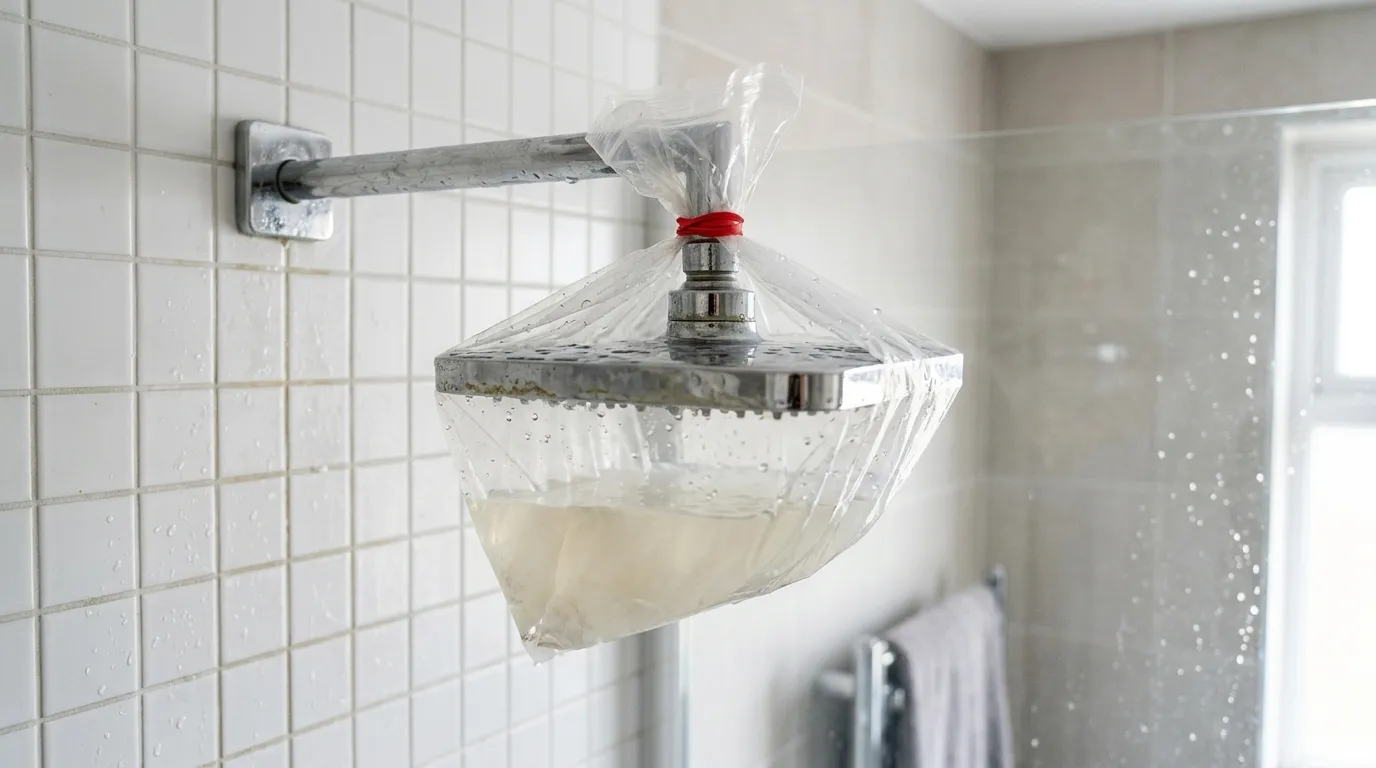
Half-fill a strong plastic bag or freezer bag with distilled white vinegar, then slip it over the shower head so the nozzles are fully submerged. Tie or hold it in place with an elastic band or a length of string looped over the arm. Leave it for around an hour (less for brass or coated heads), then remove the bag, scrub the nozzles with a toothbrush, and run the shower to rinse. It looks makeshift, but it works just as well as soaking.
Method 3: citric acid for a faster result
Citric acid, sold as a powder, is a stronger and odourless alternative to vinegar and is excellent on limescale. Dissolve a couple of tablespoons in warm water, then soak the head or use the bag method as above. It tends to work faster than vinegar and leaves no smell. Rinse well afterwards. This is the same active approach many descaling products use, and it is what we recommend for tougher jobs like an electric shower with limescale.
Finishes to be careful with
This is the part people skip and then regret. Acid can damage some finishes, so check what your shower head is made of before you soak it.
Brass: limit contact to no more than 30 minutes, as prolonged acid exposure can dull or damage the finish. Black, matte, gold, brushed and other coated finishes: avoid vinegar and acid altogether, or the coating can discolour and strip. Check the manufacturer’s cleaning advice and, if in doubt, use only warm soapy water and gentle scrubbing. Chrome and stainless steel: generally tolerate a normal soak well, but still rinse thoroughly afterwards.
When you are unsure, test on a small hidden spot first, or contact the maker. Shower brands such as Mira publish specific cleaning guidance for their heads.
How to stop it coming back
Cleaning is only half the battle in a hard water area. Give the head a quick wipe after showering to stop droplets drying into scale, and descale it every few weeks rather than waiting for the spray to clog. Some heads have flexible rubber nozzles you can rub with a thumb to pop scale off between deep cleans. The only permanent fix is treating the water itself: a water softener stops limescale forming throughout the house, so the shower head, kettle and boiler all stay clear. To find out how hard your supply is, see our guide on how to test water hardness at home.
Frequently asked questions
How do you remove limescale from a shower head? Soak the head in distilled white vinegar or a citric acid solution for around an hour, then scrub the nozzles with an old toothbrush and rinse well. If the head unscrews, soak it in a bowl; if it is fixed, tie a bag of vinegar over it so the nozzles are submerged. Run the shower afterwards to flush out loosened scale.
What is the best thing to remove limescale from a shower head? Distilled white vinegar is the cheap, effective standby, while citric acid powder dissolved in warm water works faster and has no smell. Both dissolve the calcium scale that blocks the nozzles. Avoid malt or brown vinegar, which are less effective and can stain, and avoid acids on brass, black or coated finishes.
How long should you soak a shower head in vinegar? Around an hour is ideal for chrome and stainless steel to fully dissolve the scale. Brass heads should soak for no more than 30 minutes to protect the finish, and black, gold or otherwise coated heads should not be soaked in vinegar at all. After soaking, scrub the nozzles and rinse thoroughly before refitting.
Can vinegar damage a shower head? It can damage certain finishes. Vinegar is safe on chrome and stainless steel with a normal soak, but prolonged contact can dull brass, and it can discolour or strip black, matte, gold and other coated finishes. Check what your head is made of, limit brass to 30 minutes, and avoid acids entirely on coated heads, using warm soapy water instead.
How do I stop limescale building up on my shower head? Wipe the head dry after showering, descale it every few weeks before it clogs, and rub any flexible rubber nozzles to pop off scale. In a hard water area the only permanent solution is treating the water, since a water softener stops limescale forming across the whole home, keeping the shower head and appliances clear for good.